
Quick answer: Three non-consecutive days a week is the safest starting frequency for beginners, enough to build real fitness without outrunning the body’s ability to adapt. Running every day early on is one of the most common ways new runners end up injured within the first month, not because running is inherently risky, but because the body hasn’t built the tolerance for daily impact yet.
- Fitness adaptations happen during rest, not during the run itself
- Novice runners face a meaningfully higher injury rate per hour of running than experienced runners
- Three non-consecutive days a week is a realistic, evidence-informed starting point
- Persistent fatigue and pain that doesn’t fade between runs are signs of doing too much, too soon
- A 4th or 5th day is worth adding only once the 3-day base has felt easy for several consecutive weeks
Why More Isn’t Better When You’re New

It’s a reasonable assumption, more practice usually means faster progress, but running doesn’t quite work that way for a body that hasn’t adapted to repeated impact yet.
Adaptation happens on rest days, not run days. Running stresses muscles, tendons, and bone tissue; the actual strengthening response happens afterward, during recovery, not during the session itself. Skipping rest days doesn’t add more fitness, it adds more stress on top of tissue that hasn’t finished repairing from the last run.
Injury risk also rises sharply before a base is built. A 2015 systematic review and meta-analysis in Sports Medicine found novice runners face a meaningfully higher injury rate than experienced recreational runners 17.8 injuries per 1,000 hours of running compared with 7.7 for recreational runners (Videbæk et al., 2015). That gap narrows considerably as a running base develops, which is exactly why frequency needs to start conservative and build up rather than starting at “every day” and hoping for the best.
Recommended Starting Frequency
How many days a week should a beginner actually run?
Three non-consecutive days a week is a sound, realistic default, enough total volume to build fitness steadily, with rest days built in between to let adaptation catch up.
It’s worth being honest about the evidence here rather than overselling a specific number: a 2022 systematic review in the Journal of Athletic Training found the evidence linking specific training parameters like frequency to injury risk is genuinely conflicting across studies, and cautioned against issuing universal “optimal” recommendations (Fredette et al., 2022). Three non-consecutive days isn’t a precisely proven magic number,it’s a conservative, practical starting point that respects how recovery works, and it’s the frequency most beginner programs, including the site’s own beginner running plan, are built around.
Sample Weekly Schedule
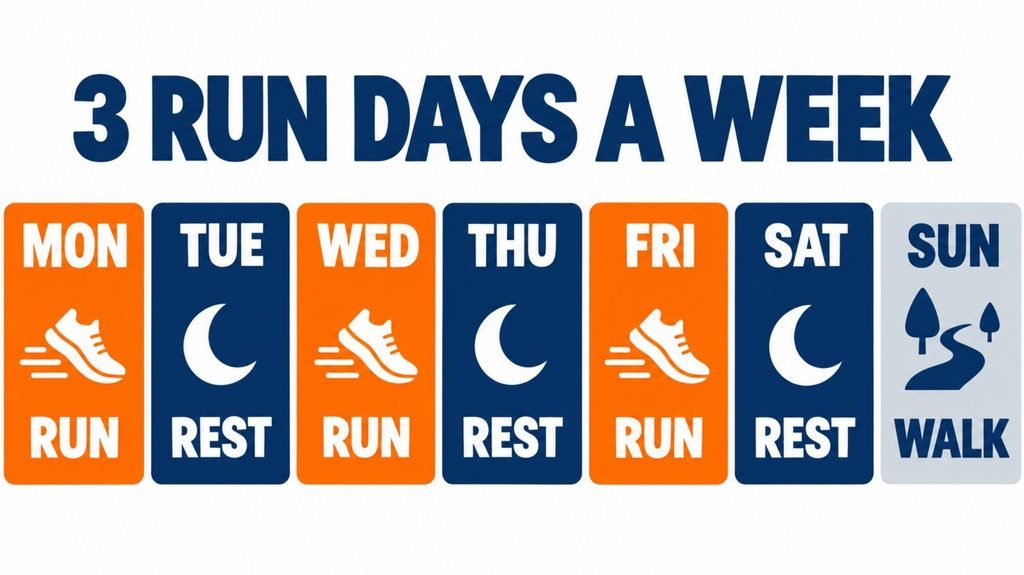
A first few weeks don’t need to be more complicated than this:
| Day | Activity |
| Monday | Run |
| Tuesday | Rest or light cross-training (walking, cycling, swimming) |
| Wednesday | Run |
| Thursday | Rest or light cross-training |
| Friday | Run |
| Saturday | Rest |
| Sunday | Optional light walk |
Non-consecutive running days give roughly 48 hours between sessions, enough time for the adaptation process to actually happen, without losing momentum during the days off. Light cross-training on off days is optional, not required; complete rest is equally valid, especially in the first few weeks. Whatever the frequency, a properly fitted pair of running shoes still does more for injury risk than almost any other single decision.
Signs You’re Running Too Often

A couple of patterns are worth watching for:
Persistent fatigue that doesn’t lift with a normal night’s sleep, and carries over from one run to the next, points to inadequate recovery between sessions rather than a normal training response.
Nagging pain that doesn’t fade between runs, as opposed to general muscle soreness that improves within a day or two, is a signal the current frequency or volume is outpacing what the body can currently handle. This is different from the expected soreness of early training; the distinguishing factor is whether it’s improving or accumulating.
When and How to Add a 4th or 5th Day
Only after the 3-day base has felt genuinely easy, not just manageable, but easy, for several consecutive weeks. Adding a 4th day too early tends to reintroduce the exact problem the 3-day structure was designed to avoid: not enough recovery time between sessions for tissue to adapt.
When the time comes, the safest approach is adding one day at a time and holding that new frequency steady for a few weeks before considering another change, rather than jumping straight to 5 or 6 days. The specifics of progressing mileage on top of frequency, rather than frequency alone,, and the physiological case for keeping rest days in the schedule even as frequency increases.
Conclusion
More isn’t automatically better when running is still new, the body needs recovery time to actually turn training into fitness, and skipping that recovery is one of the more common ways beginners end up sidelined in the first month. Three non-consecutive days a week, with rest or light cross-training in between, is a realistic and evidence-informed starting point. A 4th or 5th day can be added later, once the base frequency has felt genuinely easy for a few weeks running, not a moment sooner.
For a full plan that builds on this frequency with a run-walk structure and a first-week schedule, see How to Start Running as a Beginner.
Frequently Asked Questions
1. Can I run every day as a beginner?
It’s possible to run every day without immediate harm, but it removes the recovery windows most beginners actually need while their bodies adapt to running for the first time. Novice runners already face a higher injury rate per hour of running than experienced runners, and running daily from the start tends to compound that risk rather than reduce it.
2. Is 3 days a week enough to get in shape?
Yes, three non-consecutive days a week is enough to build meaningful running fitness over the first several weeks, especially when paired with a structured plan like a run-walk progression. Consistency over time matters more than frequency alone in the early stages.
3. How many rest days do beginners need between runs?
At least one full day between runs is a sensible starting point, which is why the 3-day schedule above alternates run days with rest or light cross-training. That gap of roughly 48 hours gives muscles, tendons, and bones time to adapt. Some beginners will want an extra rest day in a given week, and that’s a normal response rather than a setback.
4. Should I do strength training or cross-training on my off days?
It’s optional. Light activity like walking, cycling, or swimming can fit on off days, and so can basic strength work, as long as it stays easy enough that the next run isn’t affected. If an off day starts leaving legs heavy or sore for the next session, scale it back or take complete rest instead.
5. What should I do if I miss a run?
Pick up the schedule where it left off rather than doubling up runs to make up for it. Cramming extra sessions into a week undoes the recovery spacing that makes running frequency for beginners work in the first place. One missed run has almost no effect on progress, and consistency across several weeks matters far more.

One Response