
Quick answer: Couch to 5K is a free, 9-week run-walk training plan that takes a complete beginner from no running at all to running 5 kilometers (about 30 minutes) continuously, three times a week. Each week gradually increases running time and reduces walking time, letting the body adapt without the injury risk of jumping straight into continuous running.
- The full plan runs 9 weeks, with 3 runs per week
- Weeks 1–4 alternate short running and walking intervals; weeks 5–9 gradually build toward continuous running
- Repeating a week is normal and expected, not a sign of failure
- Rest days between runs are part of the plan, not optional extras
- Not finishing a full 30-minute run by week 9 doesn’t mean the plan failed, some runners need extra time, and that’s fine
What Couch to 5K Is and Who It’s For

Couch to 5K (often shortened to C25K) is a structured, 9-week run-walk plan built for people who currently do little or no running, designed to build up to a continuous 5K run gradually rather than all at once. The method is public domain and has been popularized through the NHS’s own Couch to 5K programme, which has been downloaded millions of times as a free app and podcast series.
Anyone starting from little to no running background, regardless of age or current fitness level, the plan’s entire design is built around gradual adaptation rather than assuming any existing running ability.
Who should check with a doctor before starting?
Anyone with an existing heart condition, joint problems, a recent injury, or who is pregnant should get medical clearance before beginning a new running program. This is standard pre-exercise screening advice, not specific to Couch to 5K, general guidance on when new exercisers should seek medical clearance is available through resources like the American College of Sports Medicine’s pre-participation screening guidance.
The 9-Week Schedule
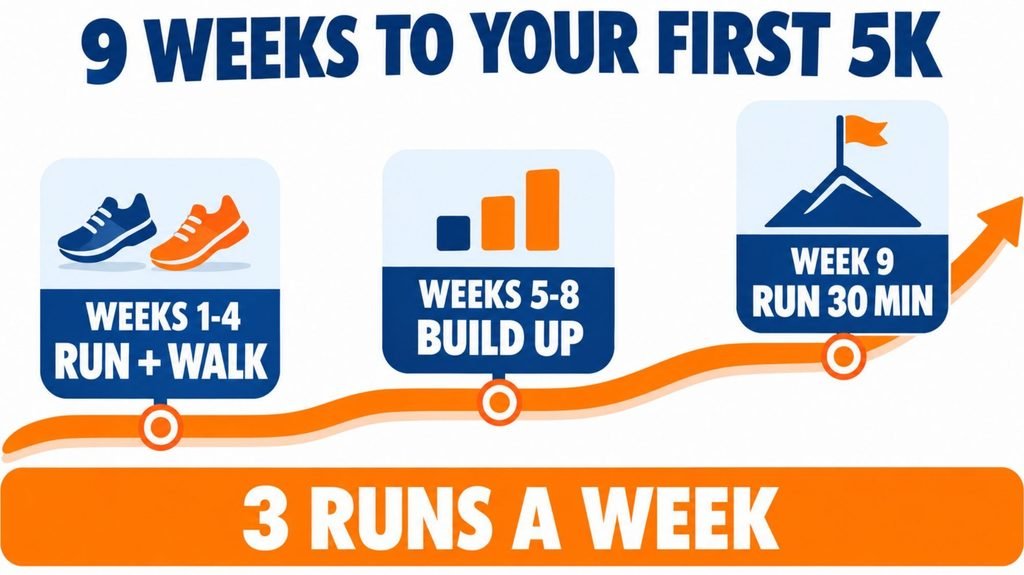
Every session begins with a brisk 5-minute walk to warm up before the running intervals start. Most weeks use the same structure for all three weekly runs; weeks 5 and 6 vary slightly between the three sessions.
| Week | Run/Walk Structure | Total Running Time |
| 1 | 5-min walk warm-up, then alternate 1 min run / 1.5 min walk, for 20 min total | ~8 min |
| 2 | 5-min walk warm-up, then alternate 1.5 min run / 2 min walk, for 20 min total | ~9 min |
| 3 | 5-min walk warm-up, then 2 rounds of: 1.5 min run, 1.5 min walk, 3 min run, 3 min walk | 9 min |
| 4 | 5-min walk warm-up, then 3 min run, 1.5 min walk, 5 min run, 2.5 min walk, 3 min run, 1.5 min walk, 5 min run | 16 min |
| 5 | Run 1: 5 min run, 3 min walk ×3. Run 2: 8 min run, 5 min walk, 8 min run. Run 3: 20 min run, no walking | Varies (15–20 min) |
| 6 | Run 1: 5 min / 3 min walk / 8 min / 3 min walk / 5 min run. Run 2: 10 min run, 3 min walk, 10 min run. Run 3: 25 min run, no walking | Varies (20–25 min) |
| 7 | 5-min walk warm-up, then 25 min continuous running | 25 min |
| 8 | 5-min walk warm-up, then 28 min continuous running | 28 min |
| 9 | 5-min walk warm-up, then 30 min continuous running (roughly 5K for most beginners) | 30 min |
Pairing the Plan With Injury-Prevention Habits

Following the schedule itself is only part of what keeps this plan injury-free. Two habits make a measurable difference alongside it:
A short warm-up beyond the brisk walk. The 5-minute walk built into every session helps, but adding a few minutes of dynamic movement, leg swings, hip circles, further prepares the joints and muscles for the running intervals ahead. The full warm-up routine for runners covers exactly what to do before lacing up.
Basic strength work on non-running days. Stronger hips, glutes, and core reduce the instability that contributes to common beginner injuries like runner’s knee. The beginner strength training guide for runners outlines a simple routine that fits alongside this schedule without adding much time.
Neither is mandatory to complete the plan, but both meaningfully lower the odds of the program getting interrupted by an overuse injury partway through.
Common Mistakes That Cause Injuries Mid-Program
- Skipping rest days between runs. The days between running sessions aren’t empty space in the schedule, they’re when the body actually adapts to the training stress. Running on consecutive days instead of spacing them out is one of the more common ways beginners derail their own progress. The science behind rest days explains why this matters more than it seems to.
- Running the intervals faster than intended. The plan is built around time, not pace, the running intervals aren’t meant to be sprinted. Beginners who push each run interval too hard often show up to the next session more fatigued than the plan accounts for, which increases injury risk over the following weeks.
- Treating every week as mandatory to complete on schedule. Life happens, energy varies, and progress isn’t meant to be perfectly linear.
What to Do If You Fall Behind or Feel Pain
Is it okay to repeat a week in Couch to 5K?
Yes, repeating any week until it feels manageable is a completely normal, built-in part of the plan, not a sign of failure or a step backward. The pace of the 9-week schedule works for a large number of beginners, but it isn’t a fixed deadline; moving to the next week only when the current one feels achievable is exactly how the plan is meant to be used.
When does pain mean stop instead of push through?
Sharp, localized pain, as opposed to general muscle fatigue or the normal soreness of using muscles that aren’t used to running, is the signal to stop and rest, not push through. The full breakdown of what normal soreness looks like versus a possible injury is covered in how to start running without getting injured, including when it’s worth seeing a doctor or physical therapist before continuing.
Conclusion
Couch to 5K works because it doesn’t ask a beginner’s body to do more than it’s ready for in any given week, the run-walk structure, gradual progression, and built-in flexibility to repeat weeks are what make it sustainable rather than just ambitious. Pairing the schedule with a proper warm-up and basic strength work on rest days rounds out an approach that gets most beginners to 30 minutes of continuous running without a mid-program injury derailing things.
Ready to start? Our Free 9-week Training Schedule for beginners.
Frequently Asked Questions
1. How long is Couch to 5K?
The standard plan runs 9 weeks, with 3 runs per week, each session lasting roughly 20 to 30 minutes including the warm-up walk.
2. Can I repeat a week if it’s too hard?
Yes. Repeating a week until it feels manageable is a normal, expected part of the plan — there’s no penalty for taking longer than 9 weeks to finish it.
3. What if I can’t run the whole 5K by week 9?
That’s fine, and it’s common. Some beginners need an extra week or two on the later stages before running continuously for 30 minutes, and repeating week 8 or 9 rather than pushing ahead is a reasonable way to close that gap.
4. Do I need a running app to follow Couch to 5K?
No, the schedule can be followed with just a phone timer or stopwatch. Apps and podcast-style audio coaching are a convenience some people prefer, not a requirement for the plan to work.
5. What should I do after finishing Couch to 5K?
Many people move on to building general running frequency and mileage rather than stopping at the 5K distance. A structured next step, along with continued attention to warm-up and strength habits, helps carry the progress forward without a new injury risk from ramping up too quickly.