
Quick answer: Beginner runners most often deal with shin splints, runner’s knee, IT band syndrome, plantar fasciitis, side stitches, black toenails, and ankle sprains, nearly all of them overuse injuries caused by doing too much too soon, weak stabilizing muscles, or worn-out footwear, rather than running itself being inherently risky.
- Most beginner running injuries share the same three root causes: rapid mileage increases, weak stabilizers, and poor footwear
- Shin splints and runner’s knee are the two most frequently reported injuries in new runners
- Each injury below has its own full guide with symptoms, treatment, and prevention in depth
- Sharp or localized pain, rather than general soreness, is the signal that one of these injuries may be developing
- Nearly every injury on this list is preventable with gradual progression, proper shoes, and basic strength work
Why Beginners Are Especially Injury-Prone

Beginners are more prone to running injuries because their bodies haven’t yet built the tolerance that experienced runners develop gradually, which makes a few common missteps disproportionately costly early on.
- Rapid mileage increases. Early motivation often outpaces the body’s actual readiness, and a systematic review on training load and running injuries found that sudden jumps in distance, frequency, or intensity are more consistently linked to injury risk than the total volume itself.
- Weak stabilizing muscles. Months or years without regular activity mean the hip, glute, and core muscles that stabilize each stride simply haven’t been asked to do this job before, leaving joints to absorb more stress than they should.
- Worn-out or wrong footwear. Shoes that don’t fit the individual’s foot type, or that have simply logged too many miles, are a recurring factor across nearly every injury on this list according to general sports-medicine overviews of running injuries.
The 7 Injuries Beginners Run Into Most
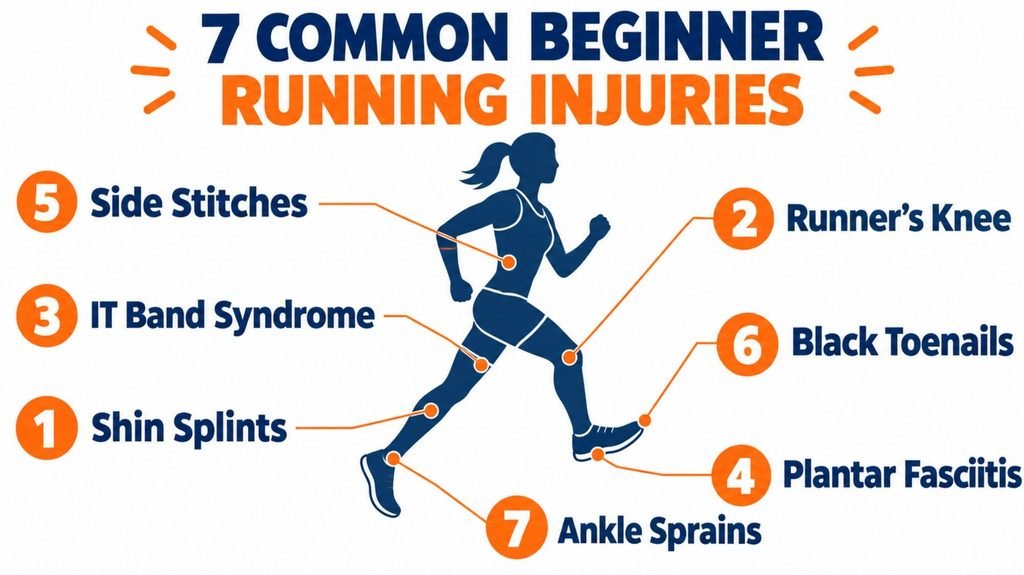
Shin Splints
A dull to sharp ache along the shin bone, usually worse during and after running, caused by repetitive stress on the tissue connecting muscle to bone. It’s one of the most frequently reported injuries among new runners specifically, often tied to a mileage increase that outpaced the body’s readiness.
Runner’s Knee
Pain around or behind the kneecap, often worse going downstairs, downhill, or after sitting for a long time. Also called patellofemoral pain syndrome, it’s frequently linked to weak hip and quad muscles that let the kneecap track slightly out of alignment during each stride.
IT Band Syndrome
A sharp or burning pain on the outside of the knee, typically appearing a few minutes into a run rather than at the start. It’s caused by irritation where the iliotibial band, a length of connective tissue running from hip to knee, rubs against the outside of the knee joint repeatedly.
Plantar Fasciitis
Heel or arch pain that’s often worse with the very first steps out of bed in the morning, caused by inflammation of the tissue supporting the arch of the foot. Increased mileage, unsupportive footwear, and tight calf muscles are common contributing factors.
Side Stitches
A sharp cramping pain, usually under the ribcage, that shows up mid-run and typically resolves once the run ends. Less serious than the other injuries on this list, but common enough among beginners to warrant its own guide on the breathing and pacing habits that reduce it.
Black Toenails
Caused by repeated friction or pressure on the toenail during longer runs, often from shoes that are laced too tight or sized too small. Uncomfortable and unsightly rather than dangerous in most cases, though persistent or worsening cases are worth a doctor’s look.
Ankle Sprains
An acute injury rather than an overuse one, usually a sudden roll or twist of the ankle on uneven ground rather than something that builds gradually like the injuries above. Prevention leans more on trail awareness and ankle stability work than on the mileage-and-footwear factors behind the rest of this list..
The 3 Root Causes Behind Most of These Injuries
Nearly every injury above traces back to one of three things:
- Too much, too soon. Whether it’s mileage, frequency, or intensity, increasing training load faster than the body can adapt is the single most common thread across this entire list.
- Poor footwear. Worn-out shoes or ones that don’t suit an individual’s foot type show up as a contributing factor in shin splints, plantar fasciitis, IT band syndrome, and black toenails alike. The beginner running shoes guide covers what actually matters when choosing a pair.
- Muscle imbalance and a weak strength base. Weak hips, glutes, and core muscles let joints absorb stress they weren’t built to handle repeatedly.
A Simple Prevention Checklist
- Increase mileage gradually, rather than jumping distance or frequency all at once, see how to start running without getting injured for the full reasoning behind this.
- Warm up properly before every run, a few minutes of dynamic movement beyond a casual walk. The warm-up routine for runners covers exactly what to do.
- Build basic strength on non-running days, targeting the hips, glutes, and core that stabilize every stride.
- Replace shoes before they’re fully worn out, and choose a pair suited to individual foot type rather than whatever’s on sale.
- Take rest days seriously, they’re when the actual adaptation happens, not dead time in the schedule.
Conclusion

Nearly every injury on this list traces back to the same handful of causes, doing too much too soon, weak stabilizing muscles, or footwear that isn’t doing its job, which means nearly all of them are preventable with the same handful of habits. This page is the map; the dedicated guides linked throughout cover each injury’s symptoms, treatment, and prevention in the depth it actually deserves.
Frequently Asked Questions
1. What is the most common running injury for beginners?
Shin splints and runner’s knee are consistently reported as the two most common injuries among new runners, both typically linked to a mileage increase the body wasn’t yet ready for.
2. How do I know if running pain is serious?
General muscle soreness is dull, spread across a wider area, and shows up a day or two after running. Sharp, localized pain, especially pain felt during the run itself, or pain that changes how someone walks, is more likely to signal an injury and is worth resting and evaluating rather than running through.
3. Can I keep running if I think I have shin splints or runner’s knee?
Mild discomfort that eases as a run goes on and settles within a day is different from pain that builds during the run or lingers afterward. If pain is getting worse, or is sharp and stays in one spot, it’s safer to cut back or rest rather than push through. Pain that doesn’t improve after a few days of reduced running is worth having checked by a doctor or physical therapist.
4. How long do beginner running injuries take to heal?
It varies widely with the injury, its severity, and how early it’s caught. Minor overuse problems often settle in a matter of weeks once training load is reduced, while more stubborn ones can take longer. Because timelines differ so much, anyone whose pain isn’t steadily improving should get an individual assessment rather than relying on a general estimate.
5. Can strength training help prevent running injuries?
Building strength in the hips, glutes, and core is a commonly recommended way to help the body handle the repeated load of running, especially for beginners coming from a sedentary base. It works best alongside gradual mileage increases and well-fitting shoes, not as a replacement for them, and no routine can guarantee an injury-free season.