Quick answer: The safest way to start running as a beginner is to build up gradually using a run-walk method, run on non-consecutive days, and increase distance slowly rather than jumping straight into continuous running. Most beginner injuries come from doing too much too soon, not from running itself being risky.
- Alternating short runs with walk breaks lets the body adapt before it’s asked to run continuously
- Three non-consecutive running days a week is a realistic, sustainable starting point
- Well-fitted running shoes matter more than any other piece of gear
- Sharp, localized pain is different from normal muscle soreness, and it’s the signal to stop, not push through
- Increasing weekly mileage gradually is a sound general habit, though the popular “10% rule” is more of a rough guideline than a precisely proven number
The Fear That Stops Most Beginners Before They Start

Somewhere between deciding to start running and actually lacing up, a specific worry tends to creep in: what if this hurts something? It’s a reasonable concern, sore shins, cranky knees, and “runner’s injuries” have a certain reputation but the injuries that derail most beginners aren’t caused by running itself. They’re caused by how it’s started.
How do I start running without getting injured?
The short version: build up gradually, mix walking with running at first instead of trying to run continuously, keep to non-consecutive running days, and treat sharp or localized pain as a stop signal rather than something to push through. None of this requires natural athleticism or a running background; it requires patience in the first few weeks, which is the part most guides skip past.
Why Most Beginners Get Hurt in the First Month
The most common cause isn’t poor form or bad luck, it’s doing too much volume, too soon, on a body that hasn’t built up the tolerance for it yet.
A few patterns show up again and again in new runners:
- Too much mileage too soon. Motivation is highest in week one, which is exactly when it’s tempting to run further or more often than the body is ready for.
- Weak stabilizing muscles from a sedentary base. Months or years of limited activity mean the muscles around the hips, knees, and ankles that stabilize each stride simply haven’t been asked to do this job before.
- Skipping rest days because motivation is high early on. Adaptation, the process that actually makes running feel easier over time happens during rest, not during the run itself.
The Run-Walk Method
What is the run-walk method, and why does it work?
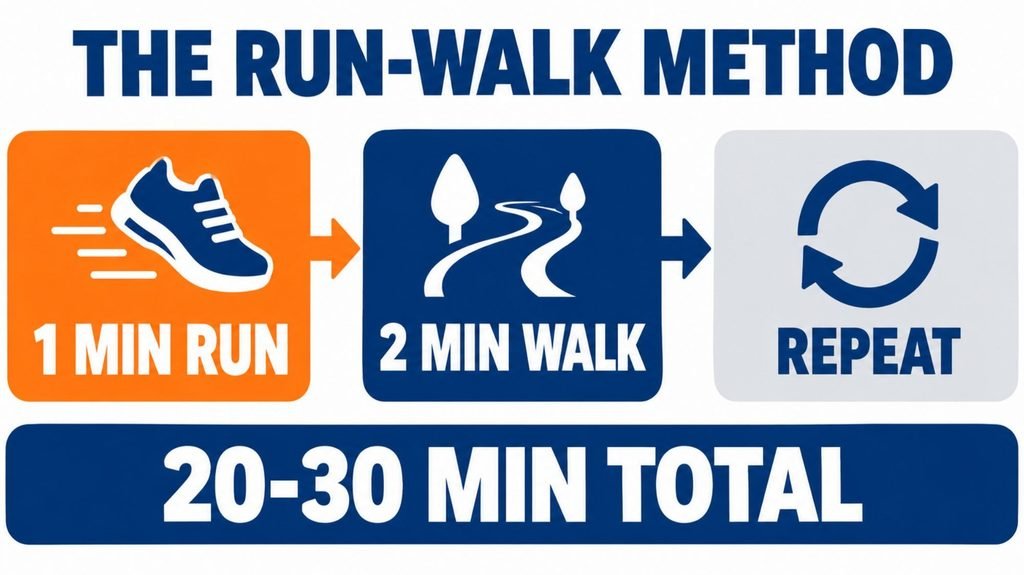
The run-walk method alternates short bursts of running with walking intervals, which lets a beginner accumulate more total time moving while giving connective tissue time to adapt before being asked to run continuously. The NHS’s Couch to 5K programme is built entirely around this principle, a nine-week plan of three runs a week that gradually shifts the balance from mostly walking to a full 30-minute continuous run by the end.
A simple starting structure looks like:
- 1 minute running, followed by 2 minutes walking, repeated for 20–30 minutes total
- As the weeks progress, the running intervals lengthen and the walking intervals shorten
This isn’t a lesser version of “real” running, it’s the version that actually builds the fitness and durability to run continuously later, without a month-long injury detour first.
Gear Basics Before You Start
Do I need special gear to start running?
Not much, but shoes are the one piece of equipment worth getting right before the first run rather than after a problem shows up. A shoe that fits properly and suits the individual foot type reduces unnecessary strain in a way that no other gear decision does at this stage.
A full breakdown of what to actually look for in a first pair of running shoes is covered in the beginner running shoes guide.
Beyond shoes, nothing else is essential in week one. Moisture-wicking clothing and a running app are nice to have, but they don’t meaningfully affect injury risk the way footwear does.
A Sample First-Week Schedule
A realistic first week doesn’t need to be complicated:
| Day | Activity |
| Monday | Run-walk session (e.g., 1 min run / 2 min walk × 8) |
| Tuesday | Rest or light walking |
| Wednesday | Run-walk session |
| Thursday | Rest or light walking |
| Friday | Run-walk session |
| Saturday | Rest |
| Sunday | Optional light walk |
Three non-consecutive running days gives connective tissue and muscles roughly 48 hours to recover between sessions, enough time for adaptation to actually happen, without losing momentum on the days in between.
Warning Signs to Stop and Rest

How do I know if it’s normal soreness or an actual injury?
Normal muscle soreness is dull, spread across a general muscle area, and shows up 24 to 48 hours after a session. According to the Cleveland Clinic, this kind of delayed-onset soreness is a normal response to challenging muscles that aren’t used to the activity, and it typically fades within a few days on its own.
An injury tends to look different: sharp, localized to one specific spot (like the outside of the knee or the front of the shin), and often noticeable during the activity itself rather than a day later.
| Normal Soreness | Possible Injury | |
| Location | General, spread across a muscle | Specific, localized to one spot |
| Timing | Appears 24–48 hours after running | Often felt during or right after running |
| Character | Dull, achy | Sharp, sudden |
| Trend | Improves within a few days | Persists or worsens |
| What to do | Continue as planned, light movement helps | Stop, rest, and consider seeing a doctor if it doesn’t improve |
Anyone experiencing sharp, localized pain that doesn’t ease with a few days of rest or any pain severe enough to change how they walk should see a doctor or physical therapist before continuing to run through it.
How to Progress Without Common Injuries
This is where a lot of running advice gets more confident than the evidence actually supports. The commonly cited “10% rule”, never increasing weekly mileage by more than 10%, is a reasonable, conservative habit, but it’s worth being honest about what’s actually behind it: a 2018 systematic review in the International Journal of Sports Physical Therapy found only limited evidence linking training load increases specifically to injury risk, and no significant difference in injury rates between a 10% and a 24% average weekly increase in one of the included studies. The 10% rule isn’t wrong, exactly it’s just a rough, conservative heuristic rather than a precisely validated threshold, and sudden, large jumps in either distance or frequency are the pattern most consistently associated with increased risk.
For a fuller breakdown of how to progress mileage sensibly week to week, see the 10% rule, explained honestly.
Rest days matter just as much as the running days themselves, since the physical adaptations from training happen during recovery, not during the run. The science behind rest days covers why skipping them tends to backfire for new runners specifically.
Common Mistakes Beginners Make
- Trying to run every day right away. Non-consecutive days give the body time to adapt; running daily from week one is one of the more common ways beginners derail their own progress.
- Ignoring shoe fit. Worn-out or poorly fitted shoes are an easy problem to avoid and a common contributor to preventable discomfort.
- Pushing through sharp pain. Treating a warning sign as something to “run off” tends to turn a minor issue into a weeks-long setback.
- Comparing pace or distance to more experienced runners too early. Progress in the first month should be measured in consistency, not speed.
Conclusion
Getting hurt isn’t an inevitable part of taking up running, it’s usually the result of doing too much before the body is ready for it. A run-walk approach, three non-consecutive running days, properly fitting shoes, and a willingness to treat sharp pain as a stop signal cover most of what actually prevents injury in the first month. None of it requires special talent, just patience in the early weeks.
For a structured next step, the Couch to 5K plan builds directly on everything above with a full week-by-week schedule.
Frequently Asked Questions
1. Is it normal to be sore after my first run?
Yes. Some muscle soreness in the 24 to 48 hours after a first run is a normal response to activity the body isn’t used to yet, and it typically improves within a few days without any specific treatment.
2. How fast should a beginner run?
Pace matters far less than consistency in the first few weeks. A comfortable, conversational pace, one where full sentences could still be spoken, is a reasonable starting point, with speed becoming relevant only once a consistent running habit is established.
3. Do I need new shoes to start running?
Properly fitted running shoes are the one piece of gear worth prioritizing before starting, since ill-fitting or worn-out shoes are a common, avoidable source of unnecessary strain.
4. How many days a week should a beginner run?
Three non-consecutive days a week is a realistic starting frequency, giving the body roughly 48 hours to recover between sessions while still building consistency.
5. When should a beginner runner see a doctor?
Sharp, localized pain that doesn’t improve within a few days of rest, or any pain severe enough to change how someone walks, is worth having checked by a doctor or physical therapist before continuing to run.

One Response